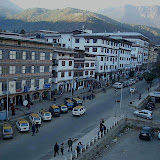
On the way back we decided to drop in to the Art Café, another recommendation from the printout. This is tucked away in a corner, next to the Swiss Bakery, and even though we were in the right place, it still took us a little while to find it. But was it worth it! It’s a cosy little coffee shop, with a coal heater and great filter coffee. Needless to say we fell in love with it immediately. Sadly it stays open only till 7pm. Obviously the coffee shop culture has not arrived in Thimphu yet. But I did find it strange that a coffee shop should stay open only in the business hours of 9am to 7pm. How do they ever manage to do any business?


A little while later, this guy who I had spotted at several places, starting with the Siliguri bus station, and later Phuntsholing, walked in with his camera bag. I decided it was time to say hello. He was Darshan, an architect from Ahmedabad. He was accompanied by a couple of pretty Bhutanese girls, both of them called Sonam. Both Sonams were very friendly and talkative. We spent some time chatting over coffee. The Art Café was their local hangout, and apparently it serves some great soups and sandwiches. We weren’t hungry, so didn’t try any.


Next on our agenda was a visit to the National Stupa. Our printouts informed us that we if we visited it in the evening, we would come across Bhutanese doing their evening prayers. We asked the two Sonams at Art Café about it, but they seemed unimpressed. To them it was just a stupa, which people visited, mostly old people, and they had not heard of any evening prayers. We decided to go anyway, much to the amusement of the two Sonams. They thought we were the religious variety. Nothing could be further from the truth. But we certainly were interested in observing if not actively exploring, the local culture. The Sonams were so familiar in a way. They were just like the millions of young Indians, dismissive of their indigenous culture, and proud of their English speaking capabilities. This atleast was my first impression, and I do hope I was wrong.
We walked to the National Stupa, and I must admit, I can understand their lack of enthusiasm. The Stupa is well, a stupa. Not much more to write about it. It seemed to have a temple, but the doors were closed, so we couldn’t actually see it. There were a lot of people around, and most of them were hurriedly making rounds of the Stupa, while chanting under their breaths. And admittedly, a lot of them were old. In fact, I got the feeling that a lot of them were on their way back home from work, and were dropping into the Stupa for a quick prayer. Part of the charm of the place is lost because of the construction going on around it. So there was a lot of scaffolding and other construction material lying around. Anyway, we played copycat and made a round of the Stupa, though with our leisurely pace, we couldn’t be more unlike the Bhutanese.
On the way back, we lost our way, and it turned out to be a longer walk than we had intended. It was getting colder and I was thankful for my monkey cap. We dropped in at Khamsa Coffee at the Cham Lam Plaza, another recommendation from the printouts, hoping for a hot cuppa while enjoying ‘the view over the surrounding mountains’, but this was not to be. It was closed, what is it with these coffee shops in Thimphu?
Back to the room in Centre Lodge, and a hot suja later, we were ready for dinner. We went across to Hotel Tandin, another recommendation from the printouts, and had a ‘wine cooler’ while we mulled over what to eat. The ‘wine cooler’ is an artificially flavoured drink that has absolutely no connection with the beverage it borrows its name from. It comes in a variety of flavours and colours. I don’t recall which one we tried, but I have a feeling they will all be equally bad. Tandin seemed to us a place for Indian food. The menu was primarily Indian, and that’s what everyone seemed to be having. So we decided to try MK instead, which claimed to serve Japanese food.


Mk is a more modest place (apologies for no pictures) on the first floor in a building just behind the cinema hall. The menu is displayed on a blackboard, in Japanese. Some had an accompanying explanation in English, but most dishes were written in Japanese. Hell, I really regret not having taken pictures! Anyway, the friendly lady who came to take the order recommended to us a soup, a dish of fried tofu with vegetables and cheese momos. Of course all these had Japanese names, and I could kick myself for not having written them down. The food was interesting, as always. My pick would be the dumplings which had a filling of cheese and some green leaf, possibly spinach.
That was our first day in Thimphu.


A little while later, this guy who I had spotted at several places, starting with the Siliguri bus station, and later Phuntsholing, walked in with his camera bag. I decided it was time to say hello. He was Darshan, an architect from Ahmedabad. He was accompanied by a couple of pretty Bhutanese girls, both of them called Sonam. Both Sonams were very friendly and talkative. We spent some time chatting over coffee. The Art Café was their local hangout, and apparently it serves some great soups and sandwiches. We weren’t hungry, so didn’t try any.


Next on our agenda was a visit to the National Stupa. Our printouts informed us that we if we visited it in the evening, we would come across Bhutanese doing their evening prayers. We asked the two Sonams at Art Café about it, but they seemed unimpressed. To them it was just a stupa, which people visited, mostly old people, and they had not heard of any evening prayers. We decided to go anyway, much to the amusement of the two Sonams. They thought we were the religious variety. Nothing could be further from the truth. But we certainly were interested in observing if not actively exploring, the local culture. The Sonams were so familiar in a way. They were just like the millions of young Indians, dismissive of their indigenous culture, and proud of their English speaking capabilities. This atleast was my first impression, and I do hope I was wrong.
We walked to the National Stupa, and I must admit, I can understand their lack of enthusiasm. The Stupa is well, a stupa. Not much more to write about it. It seemed to have a temple, but the doors were closed, so we couldn’t actually see it. There were a lot of people around, and most of them were hurriedly making rounds of the Stupa, while chanting under their breaths. And admittedly, a lot of them were old. In fact, I got the feeling that a lot of them were on their way back home from work, and were dropping into the Stupa for a quick prayer. Part of the charm of the place is lost because of the construction going on around it. So there was a lot of scaffolding and other construction material lying around. Anyway, we played copycat and made a round of the Stupa, though with our leisurely pace, we couldn’t be more unlike the Bhutanese.
On the way back, we lost our way, and it turned out to be a longer walk than we had intended. It was getting colder and I was thankful for my monkey cap. We dropped in at Khamsa Coffee at the Cham Lam Plaza, another recommendation from the printouts, hoping for a hot cuppa while enjoying ‘the view over the surrounding mountains’, but this was not to be. It was closed, what is it with these coffee shops in Thimphu?
Back to the room in Centre Lodge, and a hot suja later, we were ready for dinner. We went across to Hotel Tandin, another recommendation from the printouts, and had a ‘wine cooler’ while we mulled over what to eat. The ‘wine cooler’ is an artificially flavoured drink that has absolutely no connection with the beverage it borrows its name from. It comes in a variety of flavours and colours. I don’t recall which one we tried, but I have a feeling they will all be equally bad. Tandin seemed to us a place for Indian food. The menu was primarily Indian, and that’s what everyone seemed to be having. So we decided to try MK instead, which claimed to serve Japanese food.


Mk is a more modest place (apologies for no pictures) on the first floor in a building just behind the cinema hall. The menu is displayed on a blackboard, in Japanese. Some had an accompanying explanation in English, but most dishes were written in Japanese. Hell, I really regret not having taken pictures! Anyway, the friendly lady who came to take the order recommended to us a soup, a dish of fried tofu with vegetables and cheese momos. Of course all these had Japanese names, and I could kick myself for not having written them down. The food was interesting, as always. My pick would be the dumplings which had a filling of cheese and some green leaf, possibly spinach.
That was our first day in Thimphu.