Showing posts with label Travel. Show all posts

Sunday, August 12, 2012

Of eavesdropping on conversations in cabs...


So I overheard this rather interesting conversation today.
It so happened that I landed up in a cab with a stranger in the front  passenger seat. Cabs were hard to come by today, and we were both headed in the same direction- the cab guy was gracious enough to suggest that I hop on as well, (for he had taken on the other guy first,) and the dark, lanky passenger nodded his agreement.
As soon as the cab started the lanky boy in the front seat started fiddling with the newspaper on the dashboard.
Ye aaj ka hai?
Nahin, kal ka. Aaj ka nahin hai mere paas.
Arre, aaj ka paper dekhne ka hai.
Kyun, kya hua.
Burma mein logon ko kaat rele hain.
(Incredulous) Acchha?
Haan, bahut logon ko. Bacchon ko bhi nahin chhod rahe. Ek mahine ke bacche ka sar kaat dala. Usi ke liye log jama hai Azad Maidan pe.
Acchha? Kyun maar rahen hain.
Kya maloom, bahut kuchh to gadbad kiya rahega.
Ye Burma kidhar hai?
Nepal ke baju mein.
Acchha. matlab India mein hai?
Nahin. India mein nahin hai. India mein Assam mein maar rele hain. Kaat ke phhenk rele hai.
Acchha? TV pe dikha rahen hain ye sab.
Nahin, TV pe kahan. Sab daba dete hain aisi khabar ko. Kahin nahin milegi, na TV pe, na paper mein.

Cabdriver gets a phone call- his mom has called to apprise him of the trouble at Azad Maidan, and to ask him not to go there. He speaks to her, hangs up and relates the news to us.

At this point, my destination is near. Much as I would have liked to hear more of this conversation between the very interesting passenger and the simple, rather ignorant and easily believing cab driver, I had to ask the cab to slow down. The lanky guy shuffled around as I paid up, he got out of the cab and left without offering to share the fare.  As I entered the building, I realized he was there in the foyer, not ignoring me but not acknowledging either. We entered the lift together, and got off at the 10th floor. On the way I stole a couple of glances at him- there is something oddly familiar about him. He waits for me to get out first. Chivalry, I thought, or has he just decided to let me lead the way since I obviously know where I’m headed.
I was late, and even though I was curious to at least ask his name, or check if he has come for the screening, (in which case I would have asked him to come with me,) I just rush through to the theatre. A minute after I find myself a seat, I see him walk past and sit a few rows ahead. The first film has ended and the second one begins.
And there he is, on the screen. Videokaaran.


Sunday, December 27, 2009

About the Delhi Metro

Four months, unbelievable! And this will probably be last post of the year too… My New Year resolution should most decidedly be to write more regularly!

Two things made me come back to this rather neglected piece of cyberspace… the first was some genuine appreciation showered, quite undeservedly, especially in light of my recent disappearance, of this blog by a friend I met after a good 10 years, at a college reunion. The other was an observation I couldn’t help making while traveling in the Delhi Metro.
I love the Delhi Metro… this city badly needs better public transport, and having seen how well trains work in Mumbai, I always thought the Metro would be a great idea for Delhi. Don’t get me wrong, I have no idea whether it is the ‘ideal’ solution, nor do I know whether all the people displaced or otherwise affected by the Metro have been adequately compensated. What I do know is that the trains are fast, and they criss cross the city connecting the farthest corners, making traveling much easier (and yes, this is relatively speaking, have you ever tried getting onto the buses in Delhi?) So in that sense, the Metro is fantastic.
Besides, having travelled to Japan, and extensively in the trains there, I have realized how well a good train network can work. So what’s irking me? The design of the train! I find it strange that in a country like India, with the number of people that take public transport, the jokers have provided exactly one rod with handles to hold onto in the centre of the train. So of course the vast majority of the people do balancing acts and fall over each other every time the train starts and stops. I can imagine providing such few handles in other countries where there may not be as many people per train. But here? In Delhi? Its criminal! Haven’t they learnt anything from the Mumbai locals? I just don’t understand this lack of basic design sensibility… there is something like adapting to context! Is someone from the Delhi Metro listening?

Tuesday, August 26, 2008

Bhutan Diary 11: Onwards to Paro

(Back, after a rather long break...)
Back in Thimphu, and this time we ran out of luck with the Centre Lodge. We parked ourselves in Tandin, a hotel we had checked on the very first day. We decided to eat there as well, for lack of a better option, and I am happy to say, were pleasantly surprised. We sat at a corner table, away from the loud talking Indian crowds that seemed to be the most common of all travelers to Bhutan, and ordered a vegetable sizzler and vegetable fried rice. I remember being very happy with both dishes, so much so, that we ordered another plate of the fried rice, which we could not finish. This is mostly unthinkable for me, for I hate wasting food, and Ramya too had begun to respect this thought and all through the trip, mostly finished all but the most inedible of things on his plate. But we really were greedy that day, and paid a price for it with a heavy sense of guilt.
Over dinner Ramya told me stories of his earlier travels, most of which were undertaken alone, and were singularly unplanned. In the absence of any financial management, he had frequently run out of money, and resorted to all sorts of measures, such as borrowing from friends’ families, traveling in unreserved compartment on trains, and going without food! This trip of ours was proving to be luxurious in comparison, with me taking care of most financial management. He was occasionally piqued by the division of ‘duties’ that I did all the time, but mostly put up a brave, even smiling, face. Another interesting thing about him was how he always managed to find cigarettes. When we had started this trip, he had been most disturbed about the fact that the sale of cigarettes is banned in Bhutan. However, as far as I can recall, he never had a problem finding them.
Our next plan of action was to head to Paro. This we thought we would do by a shared cab or a bus. The next day we headed for the bus station, bag and baggage, and had no trouble finding a bus to Paro. Big mistake. The buses are mostly for the locals, who get on and off the bus anywhere, and all along the way. I lost count of the number of stops we made along the way, or the number of times I cursed myself for the unnecessary inconvenience. On the upside, it was a slice from the life of a regular Bhutanese, and to that extent, interesting. We witnessed (possibly) the first argument between two Bhutanese, the conductor and a passenger over the charges for carrying a wooden box on the bus.
Once in Paro, we started our customary search for a decent accommodation. Ramya waited with the luggage, while I looked around, but the best I could find in the deadline we gave ourselves was the Hotel Perjoling. There was another, cleaner, more spacious hotel, but it had no heater. This, as I mentioned before, was just unthinkable. We dumped our bags, and promptly headed out to grab a bite.
Paro seemed even more spread out than Thimphu, with the town centre, which is where we were at, smaller than Norzin Lam. Like Norzin Lam, there was one main street here as well, lined with shops and hotels on both sides. And needless to say, all around us in the distance were the mountains.
We looked up our printouts, and settled for the first place we saw that featured in the list. This happened to be Sonam Trophel, on the first floor, in the main street. There was little choice for vegetarians, and the gum chewing hostess seemed less than interested in serving us, even though we were the only customers in the restaurant. But the vegetable noodles, when they arrived, made up for everything. It was a delicious meal; its reputation is obviously well earned. And we finished it with tea as usual. While we were there, a big, noisy joint family came in and occupied several tables, and seemed to order every non vegetarian dish on the menu, which miraculously took no time at all to appear. Our order had taken a good fifteen minutes. Ah, I guess we were simply out of place.


At the Sonam Trophel. The restaurant had cheerful interiors and excellent food

We decided to walk around, as usual, and headed out towards the Paro dzong. Someone mentioned that it was walk-able, though I wouldn’t advise it unless you have a lot of time on your hands. We weren’t in any hurry, and it being Sunday, the Museum next to the dzong was closed. So our trip was not going to take us long anyway. We walked along the road until we came to a small wooden bridge full of prayer flags. Across the bridge and up a narrow paved path, we were directed to go by an old man hanging around. The walk up wasn’t much but it tired us out, and we had to stop along the way. I was already getting the jitterbugs just thinking about Taktsang.


Asking for directions to the dzong... one of my favourite pictures

The entrance to the Paro dzong, much like the one to the Punakha one, was up a long flight of steep steps. I suppose it was a sort of statement to build dzongs at a height and make people climb up to reach them, as these were seats of power. It was also probably out of security considerations, for the dzongs that we saw (personally or pictures of), were invariably perched on cliffs with only one point of access from the ground. The walls were high revealing nothing of the interior, and painted white, while the window frames were usually combinations of a deep brown and black, interspersed with bands of drawings in earthy shades such as ochres, oranges and reds. The entrance itself wasn’t ornamental, just a pair of huge plain wooden doors, though the long flight of steps did give it that sense of exclusive authority.


This small door was to the right of the entrance to the dzong. Beautiful view of Paro town


View of Paro

Paro dzong is smaller than the one at Punakha, but similar in every other way. Once you step through those huge wooden doors, you are immediately greeted with bright, intricately painted walls. There’s a wealth of stories on those walls which, unfortunately, we could not understand. It has a staggered entry, like in Punakha, in that when you enter you first encounter the aforementioned wall, while the door to the inside is placed to the left, out of sight if you are standing outside the doors, looking in. You enter a courtyard, which is lined on all sides with rooms on the ground and first floors. The colour scheme is the same as the outside, white walls, with wooden door frames, steps and balustrades, all painted a dark brown or black, with bands of earthy shades. In the transition spaces between courtyards, and inside the prayer rooms however, the walls are covered from floor to ceiling with paintings, depicting incidents from the lives of their mythological figures. There were monks here as well. We tried talking to a young boy monk, but he didn’t seem to understand Hindi. This seemed strange, for most locals do. Or maybe not…

Wednesday, June 25, 2008

Monsoon clouds over Kerala

Here are some pictures taken while driving through Kerala, just before the monsoons hit. I was there on an assignment and we were travelling from Calicut to Ezhimala. There was no time to stop, so all of these have been shot from the car, while on the move.


Tuesday, April 1, 2008

Bhutan Diary 10: The Punakha Dzong

Our next stop was the Punakha dzong. Dzongs are forts that used to be political and administrative centres. Some dzongs still function as government offices, and almost all functional ones also have shrines and monks residing within the premises. The Punakha dzong is beautiful, and this being our first visit to one, we didn’t know what to expect. We were stunned and awed into silence.
Here I shall let the pictures speak. They were not shot for the purpose of this blog, so they’re far from adequate. But they still speak way more than any words of mine possibly can. Suffice to say that we spent way more time here than we intended to, and dropped the idea to travel to the Wangdue Phodrang dzong.
I could however mention one little thing here. In one of the rooms on the first floor, we found a shrine. This is different from the one in the picture. Those were huge idols in a big hall. This was a lot more modest, a room with a shrine, and a monk quietly at work. He was making one of those decorative pieces with multicoloured concentric circles that we had seen in every temple we visited. We were curious about it, but the monk did not seem to speak Hindi or English. In fact he didn’t seem interested in speaking at all. What was really interesting was the material he was using, it seemed like white butter. That’s what made it so soft and easy to mould. He mixed it with colours (don’t know what he used for colours, but I could see coloured sticks lying around) to get the pastel shades. He would squeeze out a small piece from the coloured balls he’d made, and work it into a circle with his fingers. He made several of these in different sizes and colours. And then he put them together one over another in decreasing size. They stuck easily. And then would attach it to the main sculpture he was designing with a toothpick.
I wanted to stay awhile longer, spend sometime by the clear green water, but it was getting late. As I mentioned earlier, drivers in Bhutan don’t like to travel after dark, and sure enough the traffic reduces considerably as the sun goes down. We went back to Punakha town to see if we could find some more passengers to Thimphu. While the driver scouted around, Ramya and I looked for something to eat. But it was too much to ask for a sleepy little town like Punakha. One small restaurant that we found had a fixed menu that they were serving at that hour, and it was non-vegetarian. Being vegetarian really can be a huge disadvantage in some regions.
The driver hadn’t found any passengers, so we left, an uneventful drive back to Thimphu. How I missed Toshi!

Bhutan Diary 9: Punakha-a temple of 'fertility'

We woke up the next day to a beautiful morning view of Punakha. And no water!
(My lousy net connection no longer lets me upload pictures to blogger. However the pictures can be viewed here, uploaded through the Google uploader for Apple. Love Google. Love Apple. Love Canon (not relevant here, but what the hell!)
The next hour and a half was spent waiting for water, over cups of tea and coffee (I had to switch to coffee, which I felt was a safer choice, after a disastrous cup of tea), and a couple of trips to the kitchen, but mostly hanging around in the pigeon-shit infested balcony. It was a beautiful, peaceful morning, as I suspect most mornings in Punakha are. The air was clear and crisp, and in the distance, in the compound of the local temple, we could see a couple of monk boys fooling around with a hosepipe. They were probably supposed to be watering the plants, but were busy chasing each other. I was a little upset about the water situation, or atleast I wanted to be, but with each passing day I was realizing how difficult it was to be angry in that country, and indeed with its people.
Rather delayed, but well fed with a breakfast of scrambled eggs and toast, we set out to explore Punakha. Our first stop was Chimi Lhakhang, a small 15th century temple, sitting on a hillock shaped ‘like a woman’s breast’! On the way we crossed this board with posters of election candidates. Bhutan, as you might know, recently became a democracy having held their first ever election last week. This change was ushered in by none other than the King himself, another indication of the sensible, far sighted man he appeared to be. No wonder the Bhutanese dote on their King.
Our driver, this time a Nepali fellow, dropped us at the foot of the hillock at the entrance of a narrow, kachcha path. We walked through a small village and then some fields and soon enough had lost our way, which was strange because we could see the temple and so knew the general direction we were supposed to head in, but it was such a narrow path, that it was easy to get misled. There was nothing to distinguish the paths made by the villagers who worked in the fields, from the one that would have led up to the temple. Ramya realized we were off course, and we retraced our steps until we reached what we thought was the correct way. The walk up could not have taken us more than 35-40 minutes, but city bred, or should I say city spoilt as we are, breathing polluted air, and doing little by way of exercise, we were a little breathless on our way up. But the beauty of the surrounding landscape more than compensated. As we climbed up the small hillock, we realized it was surrounded by hills on all sides, and far in the distance we could see a river, on its leisurely, meandering course, while closer home in another direction was the picturesque little village we had crossed. Between the village and the hillock were stepped fields. And of course the hillsides were dotted with small white houses.
Chimi Lhakhang is a temple dedicated to fertility. It is frequented by childless couples or those who have suffered miscarriages or early deaths of their children. It is believed that the blessings received help in conception and in keeping children safe. A wooden effigy of a Drukpa Kuenley’s male organ is used to bless pilgrims. (This part I read on my way back from the temple, otherwise I would have asked to see it for sure. We weren’t ‘blessed’ with any such thing of course.)
As is usually the case, the most beautiful part of the trip was the journey, in this case, the climb up and down. We spent some time inside the shrine, but were mostly outside, walking all around the temple. While we were there, several other people came visiting, including an Indian couple that looked distinctly Bengali. We had no intention of making any polite conversations, so we steered clear of them. What fascinated me were the Bhutanese women who were walking around with complete ease in their high heels and half kiras. They weren’t exactly walking on paved roads or flat land!
Soon enough we were on our way back. This time we didn’t lose our way. We reached a little early though, our driver who had taken other passengers in order to make a little extra money while we were at Chimi Lhakhang, hadn’t yet returned. So we looked around for tea at the few small shops at the beginning of the path. Strangely enough they didn’t have tea, but a giggly young girl at the first shop offered to make some black tea. ‘No milk,’ she apologized. Ramya was happy with this too.
Then came a memorable experience for me. I wanted to pee. I asked her if I could find a toilet. She giggled some more, and told me I could use theirs. Their ‘toilet’ was a small shack at the side of the house, made with wooden planks, with gaps between the planks, and a couple of positively gaping holes. It stood on top of a pit some six feet deep, with some more planks thrown across. Below I could see the muck, though incredibly it didn’t smell much. What was a bigger source of consternation for me was a boy in the distance who had seen me enter and was looking at the shack for sure. I could see him through the damn gap, could he see me? I wont ever know of course. I took a leak as quickly as I could, and ran.
While Ramya had his tea, I took out my camera, for a beautiful shot that I didn’t get. An old man had come and parked himself on a bench right next to the window of the store, and was playing with a child, while the woman looked on from the window. But as soon as she saw the camera she backed off. No amount of persuasion worked, ‘Not interested,’ she told me emphatically.

Tuesday, February 19, 2008

Bhutan Diary 7: More Coffee, no conversation, some disappointment

Having realized that we needed to plan our trip a little more than we had earlier realized, we began the next day by a visit to the bus station. This was when the bubble burst for us. There were several things we realized over the course of the hour that we spent there. One, for instance, was that there was indeed only one bus going to Bumthang and it didn’t leave until several days later. Except that we didn’t have several days. We had a very limited stock of cash. There was also the fact that buses in Bhutan usually left early morning, or latest by afternoon, depending on the distance to be covered. It made perfect sense, Bhutan is a mountainous country, ofcourse they prefer to drive during daylight hours. No matter what the length of the journey, even a 12 hour drive would begin at 7 in the morning, rendering meaningless our plans to sightsee by day and travel by night.

The bus station is across this bridge

The buses weren’t very frequent and were usually booked in advance. I could go on, but the gist is that we realized that going to Bumthang was not a possibility anymore. We took down notes about bus timings and went across to the Art Café to discuss the next course of action.

I sulked over this changed scenario for awhile, while a rather amused Ramya shot a million pictures of me in this quiet, unhappy mood, three of which I am posting here. Ramya is like the sea, always calm, atleast at the surface. He might have been upset too, but he didn’t really show it. His response was ‘Well, I’m coming back to Bhutan!’ So a couple of coffees later, I concluded that we had better make the most of the few days we did have, which could not be achieved sulking.


Sulking at the Art Cafe


Back to the hotel, and phone calls to Tsomo at Yamphel and Kuzang, the driver who had taken us to the Changangkha temple. I enquired about making a trip to Punakha. Both suggested a day trip to Punakha, leaving early morning and returning by evening, but given our propensity to rise late, I thought leaving the same day would be a better option. This I discussed with Kuzang, who was nice enough to drop by to talk to me, and brought a thin but excellent guide to Bhutan, published by the Bhutanese government.
We were keen on making our afternoon in Thimphu a productive one, and of the many options listed in the book, we chose the Royal Academy of Performing Arts. This isn’t exactly a tourist spot, but we were very interested in seeing any local performing arts, even if it was only students practicing. A quick lunch at Chopsticks later, we were on our way.
RAPA has four divisions, the Mask dance, Music, Folk dance and Drama. We reached towards closing time, so we only managed to catch a couple of those activities. There were some students playing a local musical instrument and some others dancing in the lawn. It wasn’t the season, and there didn’t seem to be any cultural activities on at the time we were there, but we were told that in the summer, around their festival time, there are a lot of performances all over the country. Of these the mask dance is perhaps the most popular, and best recognized. The masks worn at these occasions can be seen in all handicrafts shops. They are very colourful and feisty. It must be a sight, to see so many of these, and with equally colourful costumes, dancing along the streets.

Monday, February 18, 2008

Bhutan Diary 6: Coffee and conversation in Bhutan

Back to Norzin Lam, which was feeling more and more like home ground, and we decided to try Khamsa again. We were freezing, and that seemed like a good reason to have a cup of coffee, while enjoying the ‘views over the surrounding mountains’. We reached Khamsa at six, and found two girls there, getting ready to close shop. At six? Unbelievable. It didn’t take much pleading though to convince the giggly girls to serve us coffee.


The book I am bent over is the coffee scrapbook at Khamsa. Its an indoor cafe, but it does have a wonderful view

Check out the kiras that the two are wearing. That coupled with the jacket on top is the most common dress for the women. Stripes and checks are very popular for the kiras, while the jacket is typically of a single colour

Khamsa is located on the top floor of a building called Cham Lam Plaza, and it does indeed have a wonderful view of the surrounding mountains, which at that hour were pitch dark, and dotted with lights. It was a nice enough view at night, and must be prettier by day. The coffee was good too, though I preferred Art Café’s fresh ground. Khamsa had a scrapbook full of coffee trivia, articles on coffee, its history, popularity, types etc and a whole series of cartoon strips. Interesting!
On the ground floor of the same building, we found a shop selling North Face jackets. We walked in to enquire. We were expecting to go to Bumthang and had to pick up warm clothes for the trip. The lady at the counter was most friendly and helpful. She showed us North Face jackets, told us what kind we should pick up for the cold we were likely to encounter and then talked us right out of buying anything… she and Ramya were united in their opinion that we should pick up local stuff from Bumthang. Well, I was all for local wear, so I was delighted by the idea. At this point, I should probably mention my consistent but as yet failed attempts at picking up a half kira for myself. I wanted to get something that was traditional, without burning a hole in my pocket, but it seemed just too much to ask. I hadn’t walked past a shopping street without checking out all the kiras on display, and had stepped in to a few shops, only to be disappointed by either the choice, or the price. We still came away with dirt cheap woolen socks, ‘imported from Bangladesh’. Most things in the shops in Bhutan were imported either from Bangladesh or Thailand, and priced accordingly. I had for instance bought a muffler earlier in the day, which had cost me twice of what four pairs of socks together did. I was also forced by Ramya to buy a hat! It was a very daft thing to do, but then I have to admit it did look sweet, with a bow at the back and what not. I cursed Ramya then and threatened to make him carry it, but I bought it anyway. The helpful lady gave us a discount and a travel magazine, for some articles that she thought we might want to read.
Our next stop was this awesome handicrafts shop that we had passed along the way. We walked in to just look around, and ended up spending a good hour browsing through the things on display, and finding out about the significance of anything that caught our fancy. The shop was playing beautiful music, sung by Ani Choying Dolma. The shop had several cds of her music, and the lady there was nice enough to play several tracks for us. The music was simple, with few instruments as accompaniment, but haunting. It was also perhaps one of the most calming pieces of music I have ever heard. We fell in love with it immediately. But uncertain as we were of our plans, not to mention our finances to carry them through, we didn’t pick up any. That is something I regret to this day. We thought we would at the end of the trip if we had any money left, but as it turned out, when it was time to leave, we didn’t find the opportunity.
On the other hand, we did pick up other stuff. There were these wall pieces, faces of the Buddha and princess Tara, that I just could not tear myself away from. I kept going back to the same ones; it was as if they were telling me, with their calm faces and closed eyes, that they belonged elsewhere. So we left the shop considerably poorer, but very pleased with ourselves.
We decided to eat at Comifers that night, which wasn’t easy to find. We were aided as usual by friendly locals who walked us all the way up to the restaurant, even though it was a very cold evening, and they must have been in a hurry to get someplace warm.
Comifers turned out to be a big, cheerful restaurant. It was made merrier still by a whole bunch of youngsters, almost 30-40 of them, who seemed to be having a party. They had taken up most of the tables at the place, and there were few other customers. But we found a lovely place to sit anyway, a comfortable sofa next to the bar, which we plonked ourselves on. The man behind the counter was friendly and talkative. He had been to India on several occasions and studied in Bangalore, so he seemed to connect with us easily. While chatting with him about our travel plans we realized that traveling by public transport may not be easy, for its not very frequent. Buses to Bumthang for instance run only once a week.
In reply to our enquiries about local liquor, he recommended the Bhutanese sake, and dissuaded us from trying the ‘sonfy’, which he said was the poor man’s alcohol and most unavoidable. They didn’t serve either at Comifers, but he arranged a bottle of sake for us anyway. Sake is rice beer, and best had fresh. The sake that we had that evening was a little too bitter for my taste.

Eating at Comifers. The pictures on the wall are of the King and his son, both very handsome men. The Bhutanese seem to love their king. You will find their pictures everywhere, in shops, restaurants and hotels


The food on the other hand was excellent. He helped us with the order, so I’m not quite sure what we had. I believe it was thukpa and a tofu preparation with vegetables and rice. We were so supremely happy by the end of the meal, we just had to round it off with a coffee, which sadly was Nescafe.

Saturday, February 9, 2008

Bhutan Diary 5: Permit Raj

It wasn’t my intention that there should be this long a gap between posts, but a long shoot came along, and work after all is work. Gotta make a living…
So I realized that I just about finished writing about the first day in Thimphu, and now so much time has transpired that I’m not sure I will remember all the details of the rest of the trip ☹

Day two began as lazily as usual. Throughout the trip, every single day I would resolve to make the most of the daylight hours, and that necessarily meant that we start the day early. But no matter how hard I tried, which in hindsight was not very hard, this remained a resolve. I like to pack a lot in a day when I am traveling, in an effort to collect as many experiences as I can, but the fact that I didn’t succeed this time around, says something about the laidback Bhutanese spirit, or perhaps the laidback spirit of my travel companion, or both.
At any rate, I gave in.
So we surfaced at nearly ten as usual, and made our way to the nearest travel agency, to figure out how we could make the most of our few days in Bhutan. From the material we had collected, we knew already that we wanted to go to two places for sure, the Taktshang monastery in Paro, and Bumthang, which was supposedly the ‘Switzerland’ of Bhutan. At this point I should mention the two crazy ideas that both Ramya and I had and were fairly excited about, but which we were soon to discard. We wanted to go hiking/ trekking, and spend a few days living in a monastery. The former was impossible because it was not the season, and for lack of time on our hands, and the latter because it is simply not allowed. So much for our spirit of adventure!
I should however clarify that Bhutan is supposedly an excellent trekking destination. Had we been there in the right season, and with time and money to spare, I’m sure we would have been spoilt for trekking options.
Anyhow, we landed up near the National Stupa, at a travel agency called Yangphel. The lady at the counter was most helpful, even though we made it clear from the start that we were not there to take one of their travel plans, but only needed some guidance. Hurrah for the friendly Bhutanese. There was a travel guide who chatted with us and gave us a lot of useful information. The most important discovery for us was that to visit the places that we intended to visit, we needed passes from two different departments, the applications for which were accepted only till noon. It was 11.30am. We hurried from Yamphel to the Tourism office, and filled up the forms for the road permit. Then we split and Ramya went to the hotel to put back our luggage (we had thought we would gather the information that we needed and split from Thimphu, so had checked out), while I went across to the Tourist Permit office for the individual permits for monastries and dzongs.
The Tourist Permit office was good long uphill walk away, and with every step I cursed myself for splitting duties the wrong way. I landed at the office out of breath and in a foul mood, but the friendliness of the chap there got me. Again! I wrote out an application. Even before I had finished, the man asked me a couple of questions and left the room, and returned ten minutes later with the permission letter. He then looked at my application, smiled and added a couple of more names by hand. Ofcourse I couldn’t understand a thing for the letter was in Bhutanese, but I got the impression I had permission to visit more places than I possibly could. He then showed me a book which was an internal documentation by the ministry, and which seemed interesting because it spoke about the history and culture of Bhutan. I flipped through it but realizing that I couldn’t possibly actually read it there, I asked him where I could pick up a copy. Next thing I knew I was walking back with the book tucked under my arm. By this time I was positively in love with the Bhutanese.
Lunch was at the Rice Bowl, another restaurant in the same building as our hotel. This was a recommendation too, but by one of the boys we met at the counter the first night when we had checked into Norling, who told us he was a waiter at rice bowl. We were experimental as usual with our choice of food, and most of it was interesting. A good meal can be such a mood elevator!
I spent some time checking out warm clothes while Ramya went to the Internet cafe. We had bought some in Guwahati, but not enough for a place like Bumthang. We were told it was probably snowing there.
I believe this was the day we went across to the Textile museum to kill time while we waited for the road permit. Its been a while now, and my memory is failing me about our day to day activities… needless to say I haven’t actually written an account of all this anywhere else, and I could kick myself for that!
The textile museum has samples of a lot of different kinds of textiles, most hand woven, from the 1600s to the present day. And ofcourse it talks in detail about the Bhutanese national dresses and how they are worn. There is also a demonstration room where people were busy hand knitting on small traditional wooden looms. I wonder if it can even be called a loom, it was just a wooden apparatus propped up by the women using their legs, while they sat on the floor. There seemed to be hundreds of threads stretched across and it seemed a miracle they were not all hopelessly entangled.
There was also a video room showing a short film about weaving, but the television had such a bad picture that we gave it a miss.
We collected our road pass a little after 3. With little time left before sundown, we decided our best bet was to visit someplace closeby. We chose to go to Changangkha temple. The taxi driver who drove us to the temple was friendly and seemed knowledgeable, so we took his number.


Described as one of the oldest temples in the Thimphu valley, it is dedicated to Avalokiteshwara, the Buddhist lord of compassion. The temple is on higher ground, and therefore offers beautiful views of the valley. We had to climb a flight of steps to reach the temple, and as in most Buddhist temples in Bhutan, the first thing we encountered was the prayer wheels.

Inside the temple compound were two small rooms filled with lit and unlit diyas. The main shrine was inside a bigger room on the other end of the courtyard. This temple, like a lot of others we visited in the days to come, had a side entrance. The main shrine is typically inside another room, or at the centre of one wall, and directly opposite this is a seat, with a low table in front, with some texts kept on it. This seat I assume must belong to the temple’s chief priest. The Bhutanese visiting the temple were bowing down in front of this seat too, just as they were in front of the deity. We never saw anyone actually seated on one of these, but these seats were in all temples. Perhaps they were used only on special occasions or during daily prayers, but we never had an opportunity to attend any. At any rate, it explains the side entrance. Photography was not allowed inside the temple, so there are no pictures of the inside.


The deities inside were beautiful as usual, and the temple colorful, with paintings on the walls, and the silk cloth hangings. These were made of metal though, unlike the Zangdopelri. Irrespective of the material used, the faces of the deities were always colored golden. In this case that wasn’t required, for they seemed to be made of a brass kind of material anyway. The Bhutanese have a peculiar practice, they offer just about anything in the temples. We were most amused to see packets of biscuits and chips lying as offerings. The other thing we found in this temple, and subsequently in all others were bowls full of water, typically five in number but sometimes more. Also to be found are little sculptural arrangements of lots of concentric circles, in white and pastel colours. More on this later, for after a few days, we ran into a monk making these. A peculiar thing about this particular temple was that I was not allowed to enter the shrine room. Apparently women are not allowed inside.
I did the customary turning of prayer wheels, and was marveling at the view of the valley, when Ramya disappeared down the steps. I followed soon after, only to realize that I had lost him. I went back up and found a path breaking away from the way to the temple, and leading to a small structure. From behind this structure I could hear voices and the sound of someone strumming a guitar. It was a pleasant enough tune, and I was curious to see who was playing it. It was a bunch of young boys, who promptly broke into ‘kuchh kuchh hota hai’ as soon as they saw me. One of them walked up and started apologizing for the rest. Ramya was there too, and after hanging around there for awhile, we made our way back. On the way, Ramya and I got chatting about the boys, and he asked me if I had noticed the cans of paint lying around, which indeed I had, and I had wondered what they were for. Apparently we had run into a bunch of junkies!

Sunday, February 3, 2008

Bhutan Diary 4: Coffee and conversation in Thimphu

On the way back we decided to drop in to the Art Café, another recommendation from the printout. This is tucked away in a corner, next to the Swiss Bakery, and even though we were in the right place, it still took us a little while to find it. But was it worth it! It’s a cosy little coffee shop, with a coal heater and great filter coffee. Needless to say we fell in love with it immediately. Sadly it stays open only till 7pm. Obviously the coffee shop culture has not arrived in Thimphu yet. But I did find it strange that a coffee shop should stay open only in the business hours of 9am to 7pm. How do they ever manage to do any business?


A little while later, this guy who I had spotted at several places, starting with the Siliguri bus station, and later Phuntsholing, walked in with his camera bag. I decided it was time to say hello. He was Darshan, an architect from Ahmedabad. He was accompanied by a couple of pretty Bhutanese girls, both of them called Sonam. Both Sonams were very friendly and talkative. We spent some time chatting over coffee. The Art Café was their local hangout, and apparently it serves some great soups and sandwiches. We weren’t hungry, so didn’t try any.

Next on our agenda was a visit to the National Stupa. Our printouts informed us that we if we visited it in the evening, we would come across Bhutanese doing their evening prayers. We asked the two Sonams at Art Café about it, but they seemed unimpressed. To them it was just a stupa, which people visited, mostly old people, and they had not heard of any evening prayers. We decided to go anyway, much to the amusement of the two Sonams. They thought we were the religious variety. Nothing could be further from the truth. But we certainly were interested in observing if not actively exploring, the local culture. The Sonams were so familiar in a way. They were just like the millions of young Indians, dismissive of their indigenous culture, and proud of their English speaking capabilities. This atleast was my first impression, and I do hope I was wrong.
We walked to the National Stupa, and I must admit, I can understand their lack of enthusiasm. The Stupa is well, a stupa. Not much more to write about it. It seemed to have a temple, but the doors were closed, so we couldn’t actually see it. There were a lot of people around, and most of them were hurriedly making rounds of the Stupa, while chanting under their breaths. And admittedly, a lot of them were old. In fact, I got the feeling that a lot of them were on their way back home from work, and were dropping into the Stupa for a quick prayer. Part of the charm of the place is lost because of the construction going on around it. So there was a lot of scaffolding and other construction material lying around. Anyway, we played copycat and made a round of the Stupa, though with our leisurely pace, we couldn’t be more unlike the Bhutanese.
On the way back, we lost our way, and it turned out to be a longer walk than we had intended. It was getting colder and I was thankful for my monkey cap. We dropped in at Khamsa Coffee at the Cham Lam Plaza, another recommendation from the printouts, hoping for a hot cuppa while enjoying ‘the view over the surrounding mountains’, but this was not to be. It was closed, what is it with these coffee shops in Thimphu?
Back to the room in Centre Lodge, and a hot suja later, we were ready for dinner. We went across to Hotel Tandin, another recommendation from the printouts, and had a ‘wine cooler’ while we mulled over what to eat. The ‘wine cooler’ is an artificially flavoured drink that has absolutely no connection with the beverage it borrows its name from. It comes in a variety of flavours and colours. I don’t recall which one we tried, but I have a feeling they will all be equally bad. Tandin seemed to us a place for Indian food. The menu was primarily Indian, and that’s what everyone seemed to be having. So we decided to try MK instead, which claimed to serve Japanese food.


Mk is a more modest place (apologies for no pictures) on the first floor in a building just behind the cinema hall. The menu is displayed on a blackboard, in Japanese. Some had an accompanying explanation in English, but most dishes were written in Japanese. Hell, I really regret not having taken pictures! Anyway, the friendly lady who came to take the order recommended to us a soup, a dish of fried tofu with vegetables and cheese momos. Of course all these had Japanese names, and I could kick myself for not having written them down. The food was interesting, as always. My pick would be the dumplings which had a filling of cheese and some green leaf, possibly spinach.
That was our first day in Thimphu.

Tuesday, January 8, 2008

Bhutan Diary 3: Thimphu, the capital with no traffic light

The drive to Thimphu from Phuntsholing is about 5-6 hours. It was COLD in Thimphu. We checked into Norling Hotel on the main street in the downtown Thimphu, Norzim Lam. The first couple of hours in Thimphu were spent getting used to the cold- a hot water shower followed by tea while sitting in front of the hot blower.
We started the next day by scouting around for a different hotel, for we weren’t entirely happy with Norling. A friendly man on the street just outside Norling (I can’t even remember how we got chatting!) suggested Centre Lodge to us. Centre Lodge (00975-2-334331/2) is a small hotel with just about 10-12 rooms, in the building next to the Cinema hall. It’s clean and lovely, but it really was the view that settled it for us. We grabbed it. It’s small and new, so don’t expect great service. The food comes from two restaurants downstairs, both of which are excellent, but both don’t open before 8. The reception is manned by two people, Suraj (00975-17687022), who has been to Mumbai and actually knows his Andheri from his Goregaon, and thinks Thimphu is expensive in comparison, and a girl called Sangeeta who always looks impeccable with her eye liner and dark lipstick in place and takes two steps at a time when climbing stairs.

Bhutan Diary 3: Thimphu, the capital city with no traffic lights

Next we went for a walk on Norzin Lam. By now we had read all the material we had on Bhutan and decided on the places that we might want to visit. In the process we had also realized that the trip might be longer than we had earlier anticipated, that we would miss Lensight for sure, and that we would run out of money. So in we walked into the Bank of Bhutan. We met the manager, who was sitting with the manager of a rival bank, the Bhutan National Bank, and we explained our problem. They both thought there could be ways around it, the faster one being through the BNB. Apparently BNB has an account with the Axis Bank. He asked us to get someone to deposit money into that account, with a letter stating who it’s for, including an identification such as a PANcard number, and then fax the letter to BNB. And voila we could then withdraw the money from BNB. We didn’t actually need to do this, but I wrote about it anyway because it highlights exactly how impromptu our trip had been, and therefore how ill prepared we were. But I guess ways open up when you really want something and are creative and optimistic about finding solutions.
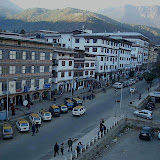
The Norzin Lam seems to be the main street in Thimphu. A lot of hotels, shops and government offices are located on it. Typically the ground floor houses the shops, while the upper floors have the hotels and restaurants. There’s a lot of car traffic on this road. I believe it’s the busiest road, and the only one in Thimphu that needs a traffic controller, who stands at the one circle from which everything seems to radiate out.
The people mostly wear traditional costumes. The men wear the gho, which is a knee length robe, while the women wear the ankle length kira. We didn’t see many women wearing the full kira though the half kira, which is like an ankle length wraparound worn differently, is very common. The full kira is a lot more complicated, and requires some amount of traditional jewellery as well to hold the garment together at the shoulders. The women top it with a kind of jacket. Both the men and the women looked most elegant in the their traditional dresses, though I did feel a little sorry for the men because it was so cold. To fight the cold they all wore socks rolled right up to their knees.
Checks seems to be the favoured pattern for both men and women, as also the traditional one, as I was informed when I tried to buy a half kira. There are some patterns and motifs which are traditional and therefore more common, although these days, almost anything goes. The cheapest half kira will cost about 350-400 rupees, and that too at the local market. At regular shops, the prices start at 450. But there is no limit to how high the price can go. There is a tradition of hand weaving in Bhutan, and hand woven kiras, with simple but elegant patterns to intricately complicated ones, in monotones to absolute riots of colour, are all available, if you can afford it. We saw kiras that cost 50-60 thousand.
Our first stop that day was the Handicrafts Museum. Our printouts informed us that they had a good collection of books, and we wanted to pick up something about Bhutanese history and culture. We spent a good couple of hours there browsing through books, and taking an occasional break to look at the other displays. They had some very interesting masks on display. Another thing that caught my eye was this blue stone that was a part of a whole lot of jewellery. There must be a significance to it. We both bought one book each, and some other small knick knacks that we couldn’t help picking up.
By this time we were famished. Lunch was at Chopsticks, a restaurant in the same building as our hotel, and a place which we would visit often over the next few days. It was an amazing lunch of Chinese food, thukpa and sizzler if I’m not mistaken. At any rate, the food here didn’t disappoint, and I loved their suja.
The next stop that day was the Zangdopelri temple. Distances in the town centre are not much, and we spent a lot of our time in Thimphu on foot. That might also have been because neither of us was in a hurry to do anything, and we enjoyed walking around, savouring the place, taking in the sights and sounds, entering shops, especially book and coffee shops and striking up conversations with the locals whenever we could.
So we checked our printouts, asked for directions, and strolled across to the Zangdopelri. This is a relatively new temple, built in the 1960s. What attracted us to it was the fact that it is supposed to be constructed on a former battle site, in order to ‘pacify energies’. It doesn’t look interesting at all from the outside, but step in for a surprise. It has some very impressive murals. The Bhutanese temples and dzongs (forts) always had the most elaborate multicoloured wall murals. They all also had wall hangings of expensive looking silk cloth, also in many colours. In the Zangdopelri, I couldn’t see an inch of empty wall space. There were many idols there, and ofcourse we didn’t then know whose they were. We later got to know that Bhutanese worship the Padmasambhava, called Guru Rinpoche (the precious teacher) by the Bhutanese, the reincarnation of the Lord Buddha, who manifested himself in eight forms. Most temples have idols of one or the other of those eight forms. There was a wealth of stories in the paintings on the walls which we understood nothing of, but were still awed by. I have to let the pictures speak the rest, no amount of writing, none that I am capable of certainly, can quite describe it anyway.
The Bhutanese have this typical way of offering their prayers, in which they fold their hands high above their heads, bring them down still folded, kneel on the ground, and go prostrate and fold their hands again, then get up and repeat the whole procedure. This is typically done three times. In the Zangdopelri we found a woman who kept doing this the entire time we were there. She had some stones with which she was keeping count. So everytime she was prostrate with her hands folded, she would move one stone from one pile to another. Ramya observed this for awhile and told me it wasn’t just a simple moving of one stone from one pile to another, but something more complicated. She was moving stones, but in some strange pattern that we couldn’t figure out. I couldn’t help but admire the muscles on her arms. Well, what do you expect, with all those near-push-ups?

Sunday, January 6, 2008

Bhutan Diary 2: Phuntsholing to Thimphu

The route to Thimphu is completely mountainous, and our taxi driver, Sonam drove like crazy as long as there was light, ignoring our pleas for tea. He finally stopped at 5:30 at a small restaurant where he had momos, and we had that life saving liquid called chai. He wanted us to have dinner as well, but dinner at 5:30? Only after we positively implored did he agree to make another stop later.
Every small and big restaurant in Bhutan seems to serve liquor. The route to Thimphu is dotted with restaurant-and-bars, as is every other place in Bhutan. It was getting to be really cold by this time. Every time Ramya opened the window for a smoke, we could feel the icy cold winds. Sonam said that it was going to be much colder in Thimphu, though it hadn’t snowed yet. ‘Shit’, I thought, ‘it snows in Thimphu’, followed by ‘whippee, it snows in Thimphu’.

We stopped at a sweet little place called Damview for dinner. I spent most of my time sitting next to this big heater, sipping hot suja, butter tea. We had some more delicious Bhutanese food, served to us by a giggling 16 year old girl called Ganga. She must have taken a liking to us, for she showed us the view of the valley from an adjoining room.
The pictures: (1) Ramya having dinner at Damview, (2) me warming my hands at the heater and (3) our driver Sonam (left) and the giggly Ganga (right)


(To be contd)

Bhutan Diary 1

One of the first things we noticed was the friendliness of the people. We needed directions to the hotel we were headed towards. The first man I asked was friendly enough, giving elaborate instructions. The next one actually walked us to the entrance to the street on which the hotel was located. Agreed it wasn’t far, but we were still impressed. And then it was the politeness and friendliness with which they would respond and try to be helpful. It was heartwarming. It led to Ramya’s second one liner, ‘I want Bhutanese citizenship.’
The hotel (Bhutan Hotel) was clean and cosy, the staff pleasant and friendly (again!) and reasonably priced. One of the men at the reception was particularly friendly and his English was excellent. His Bengali sounded equally good too. Bengali?! ‘I studied in India, in Siliguri. You have to learn Bengali when you are surrounded by Bengalis’, pat came the reply. He told me we would need our voter IDs or passports to get travel permits in Bhutan. We weren’t carrying either. We were carrying our PAN cards, and hoped they would suffice. The man wasn’t so sure.
We did, after all, sleep in Bhutan that night.
Dinner on the other hand, was another matter. By the time we freshened up and stepped out for dinner at about 9:15, everything seemed to have come to a standstill. The streets that were bustling with activity a while ago were now deserted, and we couldn’t find any restaurants open. The only one we did find had this to offer when we asked about vegetarian food, ‘chicken rice, beef rice, pork rice…’ We found one small place open though, on the Indian side, that did serve vegetarian food and with hot chapattis too. Wonderful! The food was decent, and accompanied by a Govinda film playing on TV, to an avid audience of several men. Ramya and I played a game of ‘guess the heroine’. He was sitting with his back towards the screen and trying to guess the identity of the actress from her voice. He didn’t succeed. I don’t blame him. I was looking at the screen and thought it was Farah, from the voice. It was only when a close up shot appeared could I finally tell that it was Madhavi. Oh well.
I did wonder at one point about these films from the 80s, and their strange sensibility. Ramya on the other hand said he quite enjoyed watching them as did millions of other Indians. As if to prove his point, one man at the restaurant told us he had seen the film a good twenty times already. Well, well.
The next morning I went for a walk, and had chai at the tapri from the previous evening. There were mostly men there, crowding around the tapri, and a lone woman having chai by the roadside all by herself did attract a few stares. There are absolutely no roadside chai shops in Bhutan, what a pity. Though all restaurants do serve tea. A short walk into Phuntsholing and I was at the bus station. The last bus for Thimphu is at 1:30, but there is also the option of taking a shared cab.
A little while later we were at the Bhutan tourism office trying to get our travel permits. The man at the hotel had been right ofcourse, they don’t accept PANcards. Will our trip to Bhutan be so shortlived? We weren’t willing to give up yet, so we asked if they would accept it if we got permission from the Indian immigration office (a suggestion from the friendly guy at the Bhutan hotel reception the previous night.) Yes, they would. A glimmer of hope.
On the way to the Indian immigration office, I came up with another idea. Perhaps we could call our respective families and get them to fax copies of our Voter IDs/ passports. Except that Ramya has neither. Not even a ration card. What the hell! I cursed him a bit, and reassured myself that we would find a way out of the situation yet.
As it turned out, it was a cakewalk. The guy at the Indian immigration office didn’t blink once, just asked for photostat copies of out PANcards, which we went out and got. Ofcourse Phuntsholing is a small place and you don’t exactly find photostat shops at every street corner. So when he decided to be a jerk, and sent us back for a Photostat of my driving license as well, for God-alone-knows-what purpose, I was all but ready to blow my fuse. Ramya sensed that I think, for he offered to go back for the extra photostat. After that it was quick. It helped that the man was from Delhi. Oh lord, these regionalisms amongst Indians.
Incredibly, Ramya later apologized for having stopped me from giving that man a piece of my mind. He thought it was justified and he should have let me. I thought his intervention saved us time and a lot of trouble. The man did our job, he could have held us up. This also led to a small discussion how this man managed to retain his unpleasant and unfriendly nature even when living in this beautiful, noise, traffic and pollution free little town, in the midst of the happy, friendly Bhutanese.
Back to the Bhutan tourism office. The man behind the counter there was amazing. He kept asking people to stand in a queue, and not crowd around the person whose picture was being shot. Ofcourse, Indians being Indians, there would always be some among the crowd who wouldn’t listen. So at some point he lost his temper, which is to say he spoke louder and commanded instead of requesting, and then promptly apologized. ‘You people don’t listen, you make me speak like this. I don’t like it.’ Adorable.
Next was a visit to the netcafe for Ramya and a temple for me, from where I called mom and loaded film into my camera. Our first Bhutanese lunch was at a restaurant called Capital (I think.) We started with trying out the local liquor, a shot of whisky for Ramya and gin and lime for me. I don’t remember another occasion when I drank at 12 in the afternoon but it wasn’t bad at all. For lunch we had kewa datsi, a preparation with cheese, chilli and mushrooms, and a curry with egg, I forget the name. Interesting, this datsi business. The ema datsi is the national dish of Bhutan, and made with chilli in cheese curry. That’s it, its just juicy big, green chillies, in cheese and salt and water! Made well, it tastes great. The chillies aren’t all that hot at all. Variants of this are kewa datsi and shamu datsi, made by adding potatoes or mushrooms to the same basic ingredients. Everywhere we went these are the options we got for Bhutanese vegetarian food. There really isn’t much choice for vegetarians.
By two we were armed with our permits but the last bus had left. We didn’t find any others going towards Thimphu either, so we ended up shelling out 1400/- as cab fare. We tried to pick up books or literature on Bhutan or Buddhism, as we had in Siliguri, but found nothing.

(To be contd)

Saturday, January 5, 2008

A travel tale from 2007

It seems coincidental, but also somehow appropriate that I should have been talking about happiness quotient in my last entry before I left for a shoot on Dec 9, and visited the land of the highest happiness index right afterwards. Or maybe, as I have always believed, there is nothing like a coincidence…
So it was that I found myself in Assam, on a documentary shoot, and decided the shoot absolutely had to be followed up with some travel. You don’t travel all the way to a place like Assam, to only work. Its simply not done.

Assam

To begin with, I scouted around for company. I’ve never traveled alone (though I have a feeling that too is about to happen, like a number of other firsts in the recent past), and somehow didn’t relish the idea. I didn’t have to look far. A colleague and friend Ramesh, who was sound recordist on the same shoot, was more than enthusiastic. In fact, he had similar plans. Next we scouted around for potential destinations. I haven’t explored the North East, and therefore the choices were many. Assam itself had enough to offer, and then there was Arunachal, Nagaland, Sikkim, Meghalaya, Manipur… we could take our pick. And then we realized how close Bhutan was. That settled it for us.
Thus it was that we landed in this tiny Himlayan kingdom-nation, of a small population and high happiness quotient.

The journey to Bhutan was interesting enough. We were in Duburi district in Assam when some tribal groups called for a 1000 hour bandh. (I don’t remember the name of the organization, a pathetic reminder of how far removed we all are, or atleast I am, from the goings-on of the North east. Its truly shameful and I have no excuses to offer for my ignorance. Perhaps this subject warrants a separate entry.)
To avoid the bandh we started at 3 in the morning for Guwahati. Even though we were close enough to Bhutan in Duburi itself, information about how and where we should go was hard to come by. Helpful locals told us where we could cross the border from, but what then? We didn’t just want to cross the border. We wanted to go someplace, we just didn’t know what or where that might be. Internet connections were pathetically slow. All our attempts at sourcing information from the Net resulted in more or less the same few facts rehashed by various different websites. Finally we decided we had no choice but to return to Guwahati, and take a safer, if also long and circuitous, route to Bhutan.
So we spent a day in Guwahati surfing the net, finding out bus and train timings and finally rushing to the railway booking centre to book tickets to New Jalpaiguri in an overnight train. Miraculously we got tickets, for the same day, inspite of the ‘no availability’ that the website seemed to be professing. Moral of the story: in India, there’s always a catch, whether or not you know it, or are in a position to find it.
The rest of the evening was spent in preparing for the bitter cold we would find in Bhutan. We looked for thermal inner wear, and Ramya managed to find Jockey for himself soon enough. However, for some strange reason, shopkeepers in Guwahati seem to think that women don’t need branded thermal innerwear. Or atleast not of the Jockey variety. We also picked up monkey caps, something I haven’t ever actually seen anyone wear as monkey caps. Neither would we, though we used the caps extensively. If you’re wondering at the choice of monkey caps in particular, well, try finding a headgear warm and decent, without flowers or fake nike logos or badly imitated Che Guereva staring down at you, in Paltan Bazar in Guwahati, on a Sunday at 7 in the evening.
New Jalpaiguri is the train station nearest to Siliguri, a town that is the door to several North eastern states, as well as Bhutan. We landed there the next morning, a good two hours late, and headed straight for the bus station. After waiting at the Bhutan counter for two hours we were informed that the afternoon bus for Phuntsholing wouldn’t leave that day, owing to the strike. Apparently the 42 day strike had been called off, but another one called in its place. Thankfully this one was just a day long strike, and apparently it was our destiny to be hit by a strike after all. Gloomily Ramya and I roamed around Siliguri. We went to a monastery there and a school for Buddhist studies.
(An aside: walking around the monastery, in the lookout for some information about it, we came across a monk. We tried asking him what time the prayers happen, and if there were going to be any in the evening. We got a half hearted response from him, which prompted the first of Ramya’s one-liners, ‘this guy certainly hasn’t imbibed Buddhist values. He has a long way to go to monk-hood.’)
At the school for Buddhist studies we walked into a prayer class. There was a whole bunch of young monks, the youngest not more than 8 years or so, chanting various hymns. They were led by some older ones, and every once in awhile someone would play a wind instrument or strike a hanging drum. Another older monk was distributing sheets of hymns. The students had differing levels of concentration, some fidgeting in their seats, others rocking back and forth, and one actually yawned. I have attended a prayer session many years ago in a monastery in Ladakh, and it’s all very ordered. This was so different and equally fascinating. They all had cups and glasses, no two alike, in front of them. At one point a couple of monk-boys came in with big flasks which they held with a corner of their robes, and poured a hot liquid into them. We got two cups too, of the thin white liquid. It tasted like sweetened milk, diluted with water. I have had only cow and buffalo milk, and this was neither. Ramya left his after a couple of sips. I tried to be brave, but gave up halfway through the cup.
After awhile we decided to go back to the bus station, and began to explore the possibility of going to Phuntsholing by taxi and to look for other passengers to share the fare with. We so desperately wanted to sleep in Bhutan that night. Just then voila, Ramya heard a man yelling ‘Jaigaon’. (Jaigaon is the town to the Indian side of the border with Phuntsholing.) Yippee, we’re on our way.
Its about three and a half to four hours to Bhutan by bus, depending on the traffic on the highway, and the number of stops it makes on the way. On the way, Ramya got off once for a smoke and returned grinning and showing off an unfamiliar note, Bhutanese currency! In the towns close to the border, Bhutanese currency is accepted, almost common.
Jaigaon and Phuntsholing lie side by side, the border separating them, and a huge gate called the Bhutan gate providing the point of exchange of traffic. The passage between these two is free. Its quite a sight, and we both found it most delightful. We had multiple cups of tea at a tapri on the Indian side, next to the Bhutan gate, watching the steady stream of vehicles and people going to and fro. I was grinning foolishly the entire time.

(To be contd)